In the autumn of 1621, the small settlement at Plymouth Colony prepared to celebrate a successful harvest. Only a year earlier, the settlers had arrived weak and uncertain after a long journey across the Atlantic, unsure of what the future would hold for them.
The months leading to this moment had been filled with hardship and loss. The first winter brought freezing temperatures, widespread illness, and inadequate shelter. About half of the Mayflower passengers did not survive, and those who remained carried their grief forward while continuing the difficult work of building a settlement.
As spring arrived, relationships with the Wampanoag became increasingly important. Ousamequin, also known as Massasoit, entered into an alliance with the Plymouth settlers. Tisquantum, commonly known as Squanto, became especially important as an interpreter and intermediary. He helped the English understand how to plant corn, find food, and better adapt to the unfamiliar land and its seasons.
By the time autumn returned, the settlers had gathered enough food to face another winter with greater confidence. Their crops had grown, hunting provided additional food, and for the first time since their arrival, there was reason to celebrate rather than simply survive.
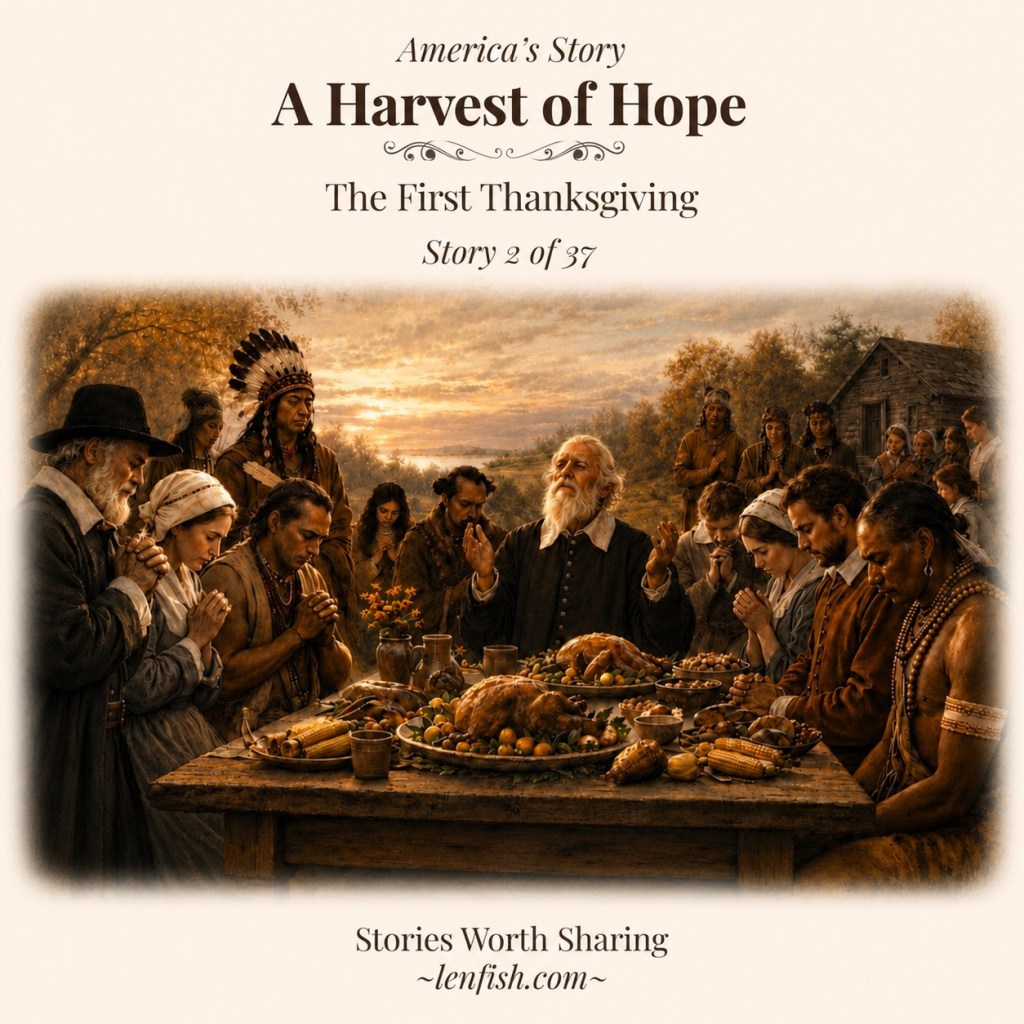
The English held a harvest celebration that included feasting and military exercises. During the gathering, Ousamequin arrived with about 90 Wampanoag men. Exactly why they came is not known. What we do know from Edward Winslow’s eyewitness account is that they remained with the English for three days.
The food was probably different from what most of us picture on a Thanksgiving table today. Winslow recorded that four Englishmen went hunting for wild fowl. Ousamequin’s men went hunting as well and brought five deer to the settlement. Corn had also been part of the successful harvest. No complete menu survives, so many of the foods traditionally associated with Thanksgiving today cannot be confirmed as part of the 1621 gathering.
This gathering was not created as the beginning of an annual Thanksgiving holiday. To the English settlers, it was more closely connected with the traditional celebration of a successful harvest. Their religious “days of thanksgiving” were different occasions devoted to prayer and giving thanks to God. Plymouth would observe one of those days in 1623 after rain brought relief from a severe drought.
The relationship between the Plymouth settlers and the Wampanoag was also more complicated than the familiar Thanksgiving story sometimes suggests. There was genuine cooperation, but there were also political interests, cultural differences, and reasons each group saw value in an alliance. The Wampanoag had lived in the region for thousands of years before the Mayflower arrived, and their side of the story is an essential part of understanding what happened in 1621.
Over time, the three-day harvest gathering came to be remembered as the First Thanksgiving. Later generations turned the event into a much larger national story, and some of the familiar traditions surrounding it developed long after the people who actually attended the gathering were gone.
Still, there is something worth remembering about those three days in 1621. Two very different groups of people, each facing their own challenges and each with their own reasons for being there, shared food and spent several days together.
The gathering did not erase their differences, nor did it guarantee what would happen in the years ahead. History rarely works that neatly.
But for a few days during the autumn of 1621, after a year marked by disease, death, uncertainty, and change, there was a successful harvest and enough food to share.
Sometimes gratitude begins with simply recognizing how far we have come.
References (Resources)
1. William Bradford, Of Plymouth Plantation — A firsthand history written by Mayflower passenger and longtime Plymouth governor William Bradford. His account describes the voyage, early Plymouth Colony, its first difficult years, and the harvest of 1621. The original manuscript is held by the State Library of Massachusetts.
2. Edward Winslow, Mourt’s Relation — Winslow’s account contains the only surviving eyewitness description of the 1621 harvest celebration. It records the three-day gathering, the hunting of wild fowl, Ousamequin’s presence with about 90 men, and their contribution of five deer.
3. Plimoth Patuxet Museums — Historical research and interpretation concerning Plymouth Colony, the 1621 harvest celebration, and the experiences of both the English colonists and the Wampanoag people.
4. Smithsonian Institution — National Museum of the American Indian — Native Knowledge 360° educational materials examining the events surrounding 1621 and placing the familiar Thanksgiving story within the broader history and perspective of the Wampanoag people.
If you missed the last story, The Mayflower Compact, discover how a group of passengers aboard the Mayflower agreed to create shared rules and govern themselves before beginning their new settlement.

