
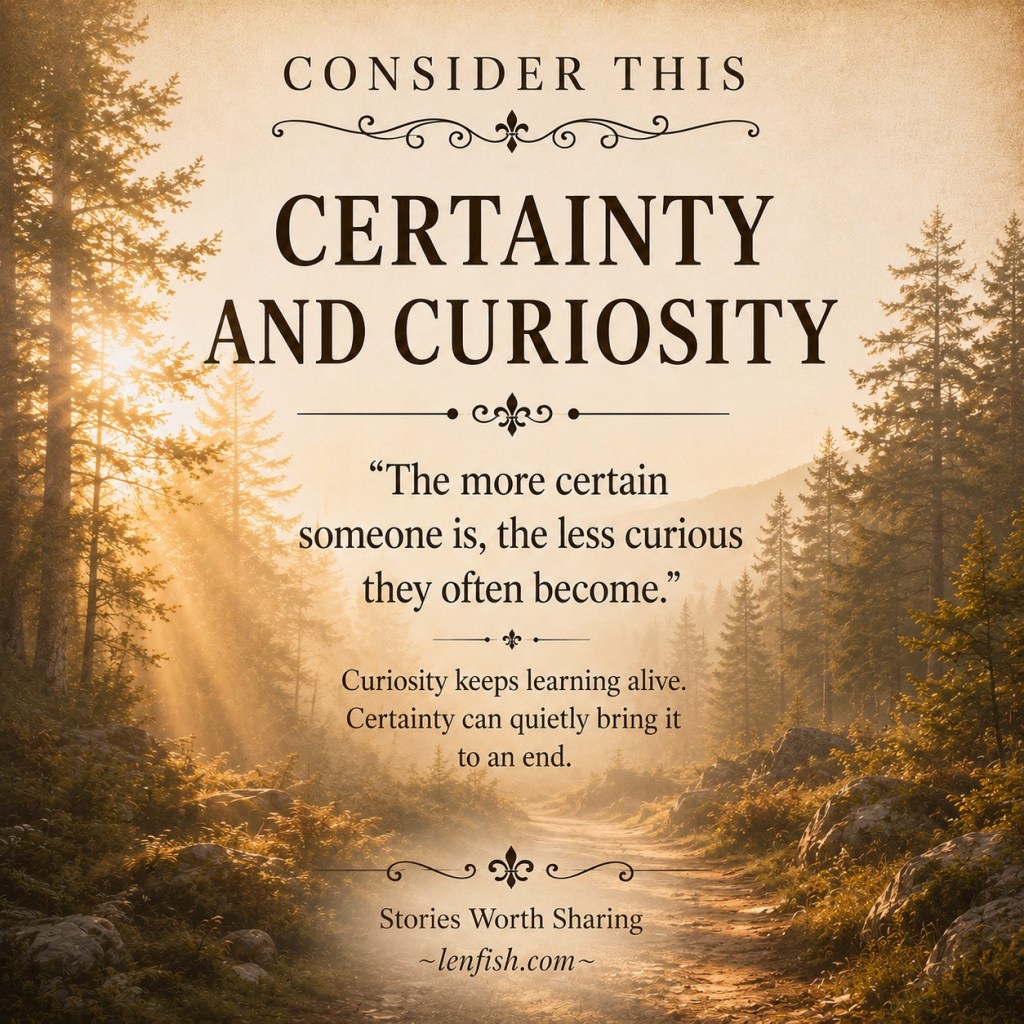
There is comfort in being certain. Certainty gives us solid ground. It tells us where we stand, what we believe, and how we understand the world. But certainty can also become a quiet stopping place. Once we are convinced that we already know the answer, we often stop asking the questions that might teach us something new.
Curiosity works differently. Curiosity doesn’t require us to abandon what we believe. It simply leaves the door open. It allows us to say, “This is what I believe today, but what else might I learn?” That small question can change the way we see people, ideas, and even ourselves.
Think about how differently we approach a conversation when we are certain we are right. Instead of listening, we prepare our response. Instead of wondering why someone sees things differently, we look for weaknesses in their argument. The conversation becomes something to win rather than an opportunity to understand.
Curiosity changes that. It asks, “Why do you see it that way?” “What experiences brought you to that conclusion?” “Is there something here I haven’t considered?” We may finish the conversation believing exactly what we believed when it began, but we will probably understand the other person better.
Some of the things we are most certain about came from what we were taught as children, what our families believed, the communities we grew up in, or experiences that shaped us along the way. Much of that wisdom may serve us well throughout our lives. But growing older gives us the opportunity to examine those ideas for ourselves instead of simply carrying them forward because they are familiar.
There is also humility in curiosity. Saying “I don’t know” isn’t a sign of weakness. Sometimes it is the beginning of wisdom. History is filled with people who discovered something important because they were willing to question what nearly everyone else considered settled.
Curiosity doesn’t mean believing everything or questioning everything endlessly. There are things we can know with confidence. The danger comes when confidence becomes so rigid that new information no longer has a way in. A strong belief should be able to survive an honest question.
Perhaps this matters most in our relationships. The people closest to us will sometimes disappoint us, confuse us, or make choices we don’t understand. Certainty quickly tells us why they did it. Curiosity asks them. One approach creates assumptions; the other creates conversation.
Maybe the goal isn’t to live without certainty. It’s to hold our certainty with enough humility to remain curious. We can have convictions and still listen, have opinions and still learn, and believe deeply while leaving room to discover that we may not have seen the whole picture. Curiosity keeps learning alive—and as long as we’re willing to keep learning, there is always room to grow.

