
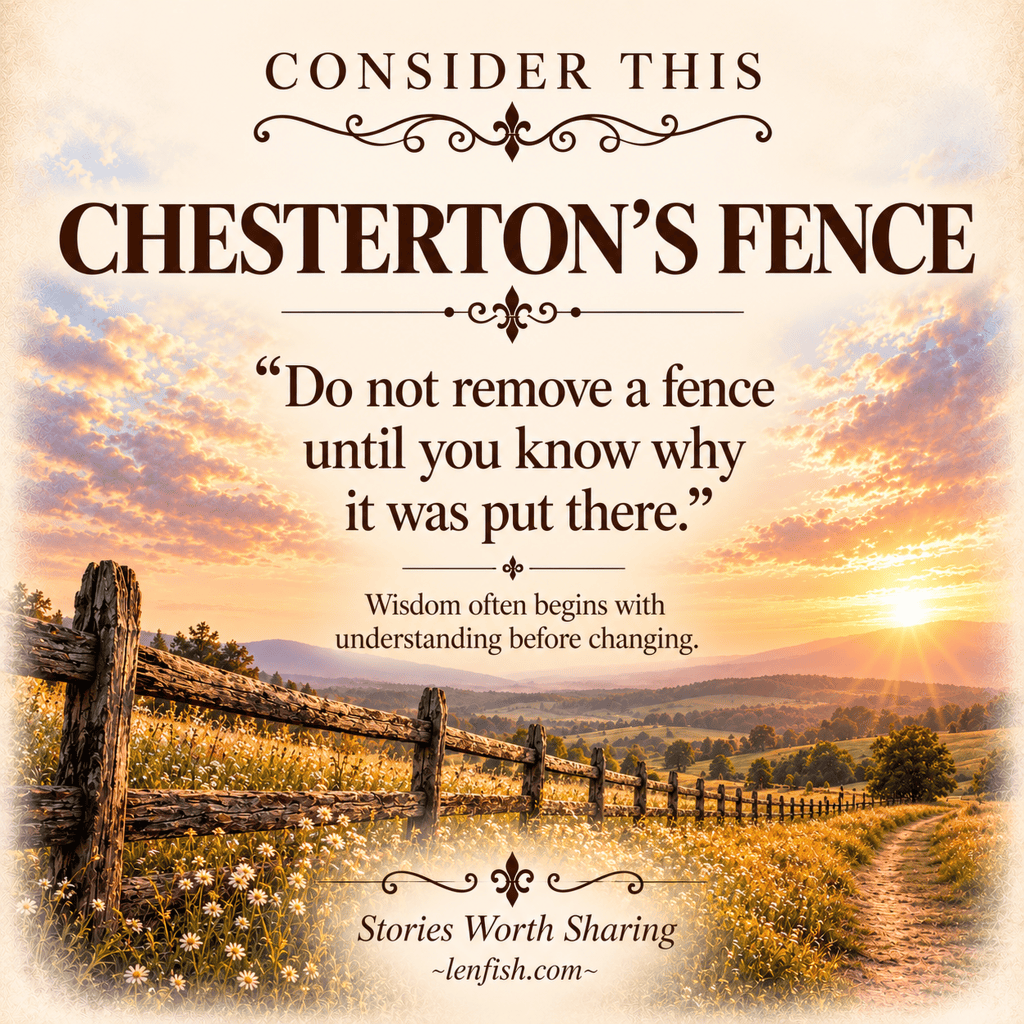
There is something tempting about looking at an old rule, tradition, or way of doing things and thinking, “We don’t need this anymore.” Sometimes we’re right. The world changes, circumstances change, and ideas that once made sense can outlive their usefulness. But before we tear down the fence, there is one important question worth asking: Why was it built in the first place?
That question is at the heart of an idea commonly called Chesterton’s Fence, named after English writer G. K. Chesterton. His point wasn’t that old rules should never be changed. It was almost the opposite. Change may be entirely appropriate—but understanding should come before change.
Imagine walking across a field and discovering a fence blocking the path. You see no cattle, no property line that seems important, and no obvious reason for the fence to exist. Removing it might seem perfectly sensible. But the fact that you don’t understand its purpose doesn’t mean it never had one.
Perhaps the cattle return during another season. Maybe the fence marks a boundary that isn’t obvious. Perhaps it protects something on one side from something on the other. Until we understand why someone went to the trouble of building it, we don’t really know what removing it might accomplish—or what problems it might create.
The same principle applies far beyond fences. Families have traditions. Businesses have procedures. Schools have rules. Communities have customs. Governments have laws. Some deserve to be changed, and occasionally they should have been changed years ago. But dismissing something simply because its purpose isn’t immediately obvious can substitute confidence for understanding.
Chesterton’s Fence also reminds us that the people who came before us weren’t necessarily foolish. They were responding to circumstances, problems, and experiences that we may no longer see. We don’t have to agree with their solution, but understanding the problem they were trying to solve gives us a much better chance of finding a better one.
This doesn’t mean tradition should automatically win. “We’ve always done it this way” isn’t a particularly convincing reason to keep doing something. Once we understand why the fence exists, we may discover that the original problem has disappeared, circumstances have changed, or there is now a better solution. At that point, removing the fence may be exactly the right decision.
There is humility in approaching change this way. Instead of beginning with “This makes no sense,” we begin with “What am I missing?” That small change in the question can open the door to history, experience, and perspectives we might otherwise overlook.
Perhaps that is the lasting wisdom of Chesterton’s Fence. Progress doesn’t require us to preserve everything from the past, and wisdom doesn’t require us to fear change. It simply asks us to understand before we act. Once we know why the fence was built, we are in a much better position to decide whether to repair it, move it—or tear it down and build something better.
Did you miss last month’s Consider This post? In The Law of Unintended Consequences, we explored what can happen when well-intended decisions produce results nobody expected. Read The Law of Unintended Consequences and discover why thinking about what might happen next can be just as important as understanding why the fence was there in the first place.

